
What to Ask Apartment Movers DC Before Relocating a Tight Studio or One Bedroom Layout

Before booking apartment movers, ask about building access, elevators, stairs, parking, furniture disassembly, packing support, loading procedures, scheduling, and included services. Studio and one-bedroom moves involve smaller inventories, but limited space, restricted access, and furniture dimensions still require careful planning.
- Confirm elevator reservations and building requirements.
- Ask which furniture needs disassembly.
- Clarify packing support and supplies.
- Check parking and loading access.
- Define the services included in your quote.
Small Apartments Still Need a Moving Plan
Studio and one-bedroom moves need a clear plan because fewer belongings do not always mean simpler access. When comparing apartment movers dc, consider the whole route: from your bed frame and kitchen boxes to the hallway, elevator, loading area, and destination doorway.
A narrow hallway can stop a sofa before loading begins. Meanwhile, parking restrictions, elevator bookings, and fixed building schedules can leave little room for changes. Limited staging space adds pressure when packed boxes block furniture or the apartment exit. Professional apartment moving provides a practical way to coordinate packing, furniture preparation, building access, loading, transportation, and destination setup. Start with an inventory and both buildings’ requirements, then agree on responsibilities before moving day.
Apartment movers DC provide relocation support for Washington, DC apartments, with services shaped by inventory, building access, and scheduling requirements. Depending on the agreement, support can include packing, furniture preparation, loading, transportation, and unloading.

Ask About Services Before Booking
Ask movers to define exactly what they will handle, what you must prepare, and what may require separate arrangements. A useful apartment moving quote connects your inventory with access conditions at both addresses, rather than treating every studio or one-bedroom move as the same project.
Send a written inventory with photos of bulky furniture. Include floor numbers, elevator details, entry restrictions, and any stops between apartments. Mention storage pickups or furniture collections before accepting a quote.
Use these questions to establish the scope:
- Included services: Does the quote cover loading, travel, unloading, and furniture placement?
- Packing assistance: Can the team pack kitchenware, electronics, and fragile decor, and who supplies materials?
- Furniture preparation: Which items need disassembly, and does the agreement include destination reassembly?
- Access conditions: How do stairs, elevators, parking, and long carries affect the plan?
- Scheduling: Can the proposed arrangements fit both move-out and move-in windows?
- Specialty items: Can the team assess heavy, delicate, or unusual belongings before booking?
- Communication: Who handles questions, inventory changes, and building instructions before arrival?
Also ask how the company handles changes to the agreed scope. An extra dresser or storage stop can affect transportation and labor needs. For a compact inventory, studio and one bedroom apartment moving services provide a relevant starting point for discussing furniture, boxes, and building access.
Why Our Team Fits Small Apartment Moves
Two Men and Van provides apartment moving, packing support, furniture disassembly, loading, unloading, and Washington, DC relocation assistance. Discuss protective wrapping, furniture placement, and optional reassembly when defining your project.
For studio and one-bedroom moves, this coordination helps reduce apartment-moving guesswork. An agreed plan supports organized loading and unloading while helping customers confirm building access before moving day.

Packing Gets Harder When Space Is Tight
Packing a small apartment requires organization because your living room, bedroom, and packing area may share the same floor space. Group belongings by use, keep exit routes clear, and label boxes for their destination so unloading does not turn the next apartment into an obstacle course.
Begin with items you rarely use. Pack seasonal clothing, spare linens, books, and decor before daily kitchen and bathroom supplies. Set aside donations and arrange disposal separately unless your mover confirms those tasks.
Use categories even when your studio has no separate rooms:
- Kitchen: Cushion dishes, separate sharp utensils, and identify fragile boxes.
- Closet: Group clothing, shoes, and accessories by storage location.
- Books: Use manageable boxes rather than filling large cartons with heavy books.
- Electronics: Label cables, photograph connections, and protect screens with suitable packing.
- Decor and fragile items: Wrap pieces individually and identify their intended placement.
- Linens and bathroom items: Pack dry textiles separately from securely closed liquids.
- Daily essentials: Keep medication, chargers, toiletries, documents, and a change of clothes with you.
Label each box with its category, contents, and destination. “Kitchen, mugs, upper cabinet” gives clearer direction than “miscellaneous.”
Keep Last-Open Boxes Within Reach
Create a last-open box for items you need until departure, such as cleaning supplies and basic utensils. Keep it separate from boxes ready for loading. At the destination, labels such as “closet shelf” or “under-bed storage” help direct placement. This matters when a stack beside the entrance would block the entire apartment.

Furniture Size Can Control the Move
large furniture and the full access route before moving day, including doorways, hallway turns, stairs, and elevator interiors. Partial disassembly may reduce an item’s width or bulk, but suitability depends on its construction, condition, and the space available at both apartments.
Measure more than the front door. A sofa might clear the entrance yet stop at a hallway corner. Similarly, an elevator’s interior may accommodate a dresser while its doorway does not.
Send photos and dimensions for items that need assessment:
- Bed frames and headboards: Identify removable rails, slats, legs, and attached storage.
- Box springs: Check dimensions against stair turns, landings, and elevator openings.
- Sectional sofas: Identify connecting sections and removable components.
- Dining tables and desks: Ask whether legs or extensions can come off.
- Shelving and dressers: Empty contents and confirm how to handle shelves and drawers.
- Large chairs: Check arm width, back height, and any removable parts.
Two Men and Van offers professional furniture disassembly services, including preparation and component labeling, with optional reassembly to confirm in your agreement.
Plan Hardware and Reassembly Together
Keep screws, brackets, and connectors in labeled bags associated with each furniture item. Photograph the assembled piece and retain instructions when available. A rigid box spring may need specialist assessment when it cannot turn through a staircase. Discuss professional box spring disassembly services before moving day rather than assuming it can bend or come apart safely.
Not every item supports disassembly. Glued joints, fragile panels, previous repairs, and construction details may limit what a mover can reasonably do.
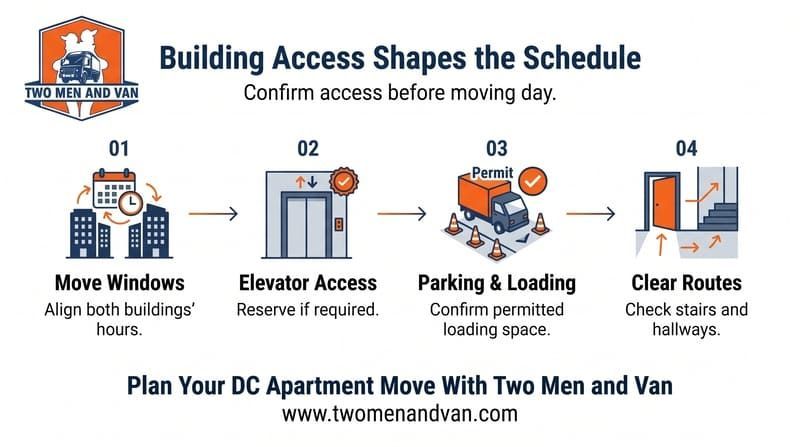
Building Access Shapes the Schedule
Confirm each building’s moving requirements before choosing a schedule, because access arrangements can control when loading and unloading happen. Elevator reservations, security procedures, loading docks, parking restrictions, and permitted move windows may differ between properties, even when the apartments sit only a few blocks apart.
Contact management at both addresses. Ask for written instructions and share them with your mover. Washington, DC apartment buildings do not all follow the same rules, so avoid relying on a previous building’s policy.
Confirm these details:
- Elevators: Reservation requirements, freight elevator access, dimensions, and approved hours.
- Stairs: Floor numbers, landing space, narrow turns, and usable entrances.
- Loading access: Dock reservations, loading zones, vehicle restrictions, and permitted parking arrangements.
- Security: Check-in procedures, keys, fobs, escorts, and required documentation.
- Building protection: Any hallway, floor, doorway, or elevator protection requirements.
- Move windows: Allowed move-out and move-in periods, including weekend restrictions.
A long carry means a longer walking route between the vehicle and apartment. A loading area behind the building may add substantial handling even when an elevator is available.
For a DC to Maryland or Northern Virginia apartment move, confirm both properties’ windows before settling on departure arrangements. Travel alone does not determine whether the schedule works. Share those details when arranging Washington DC apartment moving services, so access forms part of the plan rather than a moving-day discovery.
Sequence Loading Around the Next Apartment
A practical moving-day sequence keeps the exit clear and considers destination placement:
- Complete a walkthrough and identify items staying behind.
- Finish packing and separate personal essentials.
- Prepare furniture, label hardware, and apply suitable protective wrapping.
- Load belongings according to stability, access, and the intended unloading sequence.
- Check the apartment and follow the building’s exit procedures.
- Confirm destination access before unloading.
- Place furniture and boxes in their assigned areas.
- Complete agreed reassembly and final checks.
Discuss loading order with the crew rather than prescribing one rule for every item. Furniture placement, load stability, and building access all matter. At the destination, placing large pieces first where practical can prevent boxes from occupying their intended positions.

Moving Costs Depend on More Than Apartment Size
Apartment moving costs depend on the belongings, labor, preparation, travel, and access conditions involved, not simply the number of rooms. A studio with tight stairs and distant parking can require more coordination than a one-bedroom apartment with straightforward elevator and loading access.
Ask for an estimate based on your actual inventory and both access routes. Update the mover if your box count, furniture list, or building arrangements change.
| Project factor | Details to share before booking |
|---|---|
| Inventory volume | Apartment size, box count, furniture dimensions, and bulky pieces |
| Packing requirements | Full packing, selected fragile items, or transport-ready boxes |
| Furniture preparation | Disassembly, protective wrapping, hardware handling, and reassembly |
| Building access | Stairs, elevator reservations, loading restrictions, and carry distance |
| Transportation | Travel distance, parking access, and number of stops |
| Additional needs | Specialty items, storage arrangements, and crew requirements |
When discussing professional local moving services, connect each requested task to the quote. Do not assume packing, storage, disposal, or reassembly comes with transportation. A studio move is not automatically cheaper or easier. Difficult stairs, limited parking, or a narrow move window can change the project scope.
When Apartment Moving Assistance Makes Sense
Professional help can reduce moving-day workload when access and preparation compete for your time. It can be particularly useful with:
- Tight staircases, elevator scheduling, or limited parking.
- Large furniture, heavy items, or disassembly needs.
- A substantial packing workload alongside work or lease deadlines.
- Multiple stops or same-day access windows at both buildings.
- Apartment-to-apartment moves with little staging space.
For example, a couple moving between one-bedroom apartments may need bed preparation while keeping both elevator reservations workable. Coordinating those tasks in advance may reduce avoidable delays caused by poor preparation.
Professional assistance does not remove building restrictions. It helps keep apartment logistics organized around them.
Book Apartment Movers DC Today
Packing, furniture disassembly, building access, loading, transportation, unloading, and destination setup work better as one coordinated plan. When comparing apartment movers dc, provide your inventory and access details so the proposed service matches your apartment.
Two Men and Van offers apartment moving and packing services for customers who need help preparing and relocating household belongings. Confirm requested tasks, property requirements, and scheduling before booking.
Plan Your Washington, DC Studio or One-Bedroom Move
Renters, apartment residents, landlords, and property managers across Washington, DC, Maryland, and Northern Virginia can discuss their apartment relocation needs. Service is also available across Delaware and Pennsylvania, with arrangements subject to location, project review, and scheduling.
Gather furniture photos, addresses, floor numbers, elevator details, and proposed move windows, then request an apartment moving quote. Clear information helps define the work before moving day.
Frequently Asked Questions
What should I ask apartment movers before booking?
Ask apartment movers dc about included services, packing, disassembly, access, scheduling, travel, and communication.
Do apartment movers help with packing?
Some movers offer packing assistance, but you should confirm materials, responsibilities, and included tasks before booking.
Can movers disassemble beds and sofas?
Movers may disassemble suitable beds and sofas after assessing construction, condition, dimensions, and access.
Do I need to reserve an elevator before moving?
Ask building management whether your move requires an elevator reservation, freight elevator, or approved access window.
How should I prepare a studio apartment for moving day?
Label boxes, clear walking routes, separate essentials, and confirm furniture preparation and building access.
What affects the cost of a one-bedroom apartment move?
Inventory, packing, disassembly, stairs, carry distance, parking, travel, stops, and building restrictions affect project scope and cost.
Can movers handle tight staircases and hallways?
Suitability depends on furniture dimensions, item construction, staircase turns, hallway clearance, and the agreed handling plan.
How early should I book apartment movers in DC?
Contact movers once your dates become clear, then confirm availability alongside both buildings’ access requirements.
Connect With Us
Stay connected with us for moving tips, customer stories, special promotions, and behind-the-scenes content. Follow Two Men and Van on social media to get helpful advice and updates on our services across Maryland, DC, Northern Virginia, Pennsylvania, and Delaware.
- Facebook - Join our community for moving tips and seasonal offers
- Instagram - See real moves, packing hacks, and customer testimonials
- Instagram Washington - Follow our Washington area team for local moving insights
Get inspired, ask questions, and see why thousands of customers trust Two Men and Van for their interstate and local moves.